
Werk:Die Theologie der Arithmetik/Glossar
Werk:The Theology of Arithmetic/Glossary
Gespräch:Übersetzung Die Theologie der Arithmetik Glossar
It is impossible, of course, to know in advance which of the many technical terms that appear in our treatise will not be familiar to readers. This glossary contains only the most outlandish and/or most peculiarly Greek mathematical terminology. Any gaps can be filled, and further information provided, by works mentioned in the Bibliography.
- Es ist natürlich unmöglich, im Voraus zu wissen, welcher der vielen Fachbegriffe, die in unserer Abhandlung vorkommen, den Lesern nicht vertraut sein wird. Dieses Glossar enthält nur die fremdartigste und/oder am spezifischsten griechische mathematische Terminologie. Etwaige Lücken können durch die in der Bibliographie genannten Werke gefüllt und weitere Informationen bereitgestellt werden.
- A. Types of Number
- Circular: A square number whose last digit is the same as the last digit of the side number (root); so a circular number is bound to end in 1, 5 or 6. Examples: 25 (52), 1296 (362).
- automorphe Zahl: Eine Quadratzahl, deren letzte Ziffer dieselbe ist wie die der Seitenzahl (Quadratwurzel); also muss eine Kreiszahl auf 1, 5 oder 6 enden. Beispiele: 25 (52), 1296 (362).
- Kreisförmig (kyklikós / κυκλικός): Eine Quadratzahl (tetrágōnos arithmós / τετράγωνος ἀριθμός), deren letzte Ziffer dieselbe ist wie die letzte Ziffer der Seitenzahl (pleurá / πλευρά) (Wurzel); daher endet eine kreisförmige Zahl (kyklikòs arithmós) zwangsläufig auf 1, 5 oder 6. Beispiele: 25 (52), 1296 (362).
- Composite: see Secondary.
- Cube: A number which can be portrayed as a cubical array of evenly spaced dots. These are the familiar cubes. Also called 'equal-times-equal-times-equal.' Note that the first cube is the sum of the first odd number (1); the second cube is the sum of the next two odd numbers (3, 5); the third cube of the next three, and so on. See also: Spherical.
- Kývos-Arithme / Würfel-Arithme (kývos arithmós / κύβος ἀριθμός): Eine Arithme, die als eine würfelförmige Anordnung von gleichmäßig verteilten Punkten (psēphoi) dargestellt werden kann. Dies sind die vertrauten Würfel. Auch „Gleich-mal-Gleich-mal-Gleich“ (isákis ísos isákis / ἰσάκις ἴσος ἰσάκις) genannt. Beachte, dass die erste Kývos-Arithme die Summe der ersten ungeraden Arithme (1) ist ; die zweite Kývos-Arithme ist die Summe der nächsten zwei ungeraden Arithmen (3, 5) ; die dritte Kývos-Arithme die Summe der nächsten drei, und so weiter. Siehe auch: Sphärisch.
- Defective: A number which is greater than the sum of its factors. Example: 8, whose factors (1, 2, 4) add up to 7.
- Mangelhafte Arithme (ellipēs arithmós / ἐλλιπὴς ἀριθμός): Eine Arithme, die größer ist als die Summe ihrer Teile (merē / μέρη). Beispiel: 8, deren Teile (1, 2, 4) sich zu 7 summieren.
- Diagonal: A number considered as the diagonal of a square. See also under Side.
- diametrik-Arithme (diametrikòs arithmós / διαμετρικός ἀριθμός): Eine Arithme, die als die Diametrische (diámetros / διάμετρος) eines Quadrats (tetrágnos / τετράγωνος) betrachtet wird. Siehe auch unter Seite (pleurá / πλευρά).
- Even: A number which can be divided into two equal parts and into two unequal parts. Hence 2, which can be divided only into two equal parts, is a source of number, rather than an actual number.
- Gerade Arithme (ártios arithmós / ἄρτιος ἀριθμός): Eine Arithme, die in zwei gleiche Teile (ísos / ἴσος) und in zwei ungleiche Teile (ánisos / ἄνισος) geteilt werden kann. Daher ist die 2 (Dyade), die nur in zwei gleiche Teile geteilt werden kann, eher eine Quelle (archē) der Arithme als eine tatsächliche Arithme.
- Even-odd: A number which is even, but whose half is odd. There is also a loose sense of the term, in which it means 'both even and odd at once.'
- Even-times-even: To earlier Greek mathematicians, this was any number which is the product of two even numbers. To later mathematicians, it is a number which can be successively halved down to 1. Example: 16, halved to 8, 4, 2, 1.
- Imperfect: See Defective.
- Incomposite: See Prime.
- Linear: A number represented as a straight line of dots. Thus any number can be linear, but only prime numbers are exclusively linear, since they cannot be plane or solid numbers.
- Lineare Arithme (grammikòs arithmós / γραμμικὸς ἀριθμός): Eine Arithme, die als eine gerade Linie aus Punkten (pseˉphoi) dargestellt wird. Somit kann jede Arithme linear sein, aber nur Prim-Arithmen (pr\bar{o}tos arithmós / πρῶτος ἀριθμός) sind ausschließlich linear, da sie keine Flächen- oder Körper-Arithmen sein können.
- Mixed: A secondary number which shares with some other secondary number no factor except for 1. Example: 9 and 25 are mixed in relation to each other, since their factors (3 and 5 respectively) do not overlap.
- Oblong: A number which can be portrayed as an oblong of dots. Note that what I have translated as 'oblong' numbers are always 'heteromecic'—that is, their sides differ by 1: 6 is 3 x 2, 12 is 4 x 3, and so on. Note also that any oblong number is the sum of two equal triangular numbers, and that oblong numbers are formed by the addition of any number of successive even numbers in the sequence of natural numbers (see also under Gnomon): 2 + 4 = 6, 2 + 4 + 6 = 12, etc.
- Längliche Arithme (heteromékēs arithmós / ἑτερομήκης ἀριθμός): Eine Arithme, die als ein Rechteck (oblong) aus Punkten dargestellt werden kann. Beachte, dass die Arithmen, die ich als „länglich“ (oblong) übersetzt habe, immer „heteromekisch“ sind – das heißt, ihre Seiten (pleurá / πλευρά) unterscheiden sich um genau 1 : 6 ist 3 × 2, 12 ist 4 × 3 und so weiter. Beachte auch, dass jede längliche Arithme die Summe zweier gleicher Dreiecks-Arithmen (trígōnos arithmós / τρίγωνος ἀριθμός) ist und dass längliche Arithmen durch die Addition einer beliebigen Anzahl aufeinanderfolgender gerader Arithmen (ártios arithmós / ἄρτιος ἀριθμός) in der Folge der natürlichen Zahlen gebildet werden (siehe auch unter Gnomon ): 2 + 4 = 6, 2 + 4 + 6 = 12, etc..
- Odd: A number which can be divided only into two unequal parts, of which one is odd and the other even.
- Ungerade Arithme (perittós arithmós / περιττὸς ἀριθμός): Eine Arithme, die nur in zwei ungleiche Teile (ánisos merē / ἄνισα μέρη) geteilt werden kann, von denen einer ungerade (perittós) und der andere gerade (ártios) ist.
- Odd-even: An even number which becomes odd when divided by some power of 2. Example: 24, successively divided into 12, 6, 3.
- Over-perfect: A number which is less than the sum of its factors. Example: 12, whose factors (1, 2, 3, 4, 6) add up to 16.
- Perfect: Strictly, a perfect (or 'complete') number is one which is equal to the sum of its factors. Example: 6, whose factors are 1, 2, 3. But numbers could also be called perfect in less strictly mathematical senses (see e.g. pp. 60-61.)
- Vollkommene Arithme (téleios arithmós / τέλειος ἀριθμός): Im strengen Sinne ist eine vollkommene (oder „vollständige“) Arithme eine solche, die gleich der Summe ihrer Teile (merē / μέρη) ist. Beispiel: 6, deren Teile 1, 2 und 3 sind. Arithmen konnten jedoch auch in einem weniger strengen mathematischen Sinne als vollkommen bezeichnet werden.
- Plane: A number which can be portrayed as an array of evenly spaced dots in the shape of a plane figure. See: Triangular, Square, Oblong, Polygonal.
- Polygonal: A number which can be portrayed as dots in the shape of a polygon. See also under Gnomon.
- Prime and incomposite: A number which can be measured or factored only by 1 and by itself. Earlier Greek mathematicians regarded 2 as prime, as we do today; but for later writers this category of number was one of the three categories of odd number (see also: Secondary, Mixed), to balance the three categories of even number (see: Even-times-even, Even-odd, Odd-even).
- Rectilinear: see Linear.
- Recurrent: see Spherical.
- Scalene: A solid number which is the product of three unequal numbers. Example: 64, seen as the product of 2 x 4 x 8.
- Secondary and composite: To earlier Greek mathematicians, a composite number is any number which is not prime. To later mathematicians, secondary and composite numbers were one of the three classes of odd number (see under Prime): they are odd numbers whose factors are both odd and prime. Example: 15, whose factors are 3 and 5.
- Side: A number considered as the side of a plane or solid figured number. Hence 'side' has sometimes been translated as 'square root' (where it is the side of a square) and 'factor' (where it is the side of an oblong). Side numbers are often paired with diagonal numbers, because the Pythagoreans used the relation between the side and the diagonal of a square to prove the irrationality of √2, and to find successive approximations to √2.
- Seite (pleurá / πλευρά): Eine Zahl, die als die Seite (pleurá) einer ebenen (epípedos / ἐπίπεδος) oder festen (stereós / στερεός) Figurenzahl (eidopoiētheìs arithmós / εἰδοποιηθεὶς ἀριθμός) betrachtet wird. Daher wurde „Seite“ (pleurá) manchmal als „Quadratwurzel“ übersetzt (wo sie die Seite eines Quadrats [tetrágōnos / τετράγωνος] ist) und als „Faktor“ (wo sie die Seite einer länglichen Zahl [heteromḗkēs / ἑτερομήκης] ist). Seitenzahlen (pleurikoì arithmoí / πλευρικοὶ ἀριθμοί) werden oft mit Diagonalzahlen (diametrikoì arithmoí / διαμετρικοὶ ἀριθμοί) gepaart, da die Pythagoreer die Beziehung zwischen der Seite (pleurá) und der Diagonale (diámetros / διάμετρος) eines Quadrats nutzten, um die Irrationalität von √2 zu beweisen und um schrittweise Annäherungen an √2 zu finden.
- Solid: A number which can be portrayed as a three-dimensional array of evenly spaced dots. See: Cube, Scalene.
- Spherical: A cube number whose last digit is the same as the last digit of the side number. Also called 'recurrent.' So a spherical number is bound to end in 1, 5 or 6. Examples: 216 (63), 1331 (113).
- Sphärische Arithme (sphairikós arithmós / σφαιρικὸς ἀριθμός): Eine Kubikzahl (kybikòs arithmós / κυβικὸς ἀριθμός), deren letzte Ziffer dieselbe ist wie die letzte Ziffer der Seitenzahl (pleurá / πλευρά). Auch „wiederkehrend“ (epaktikós / ἐπακτικός) genannt. Daher endet eine sphärische Arithme zwangsläufig auf 1, 5 oder 6. Beispiele: 216(63), 1331 (113).
- Square: A number which can be portrayed as a square of evenly spaced dots. These are the familiar square numbers. Also called 'equal-times-equal.' Note that square numbers are formed by the addition of any number of successive odd numbers in the sequence of natural numbers (see also under G nom on): 1 + 3 = 4, 1 + 3 + 5 = 9, etc. See also: Circular.
- Submultiple: The opposite to a multiple, i.e. a number which cannot be factorized (and is therefore prime), but which is a factor of some other number.
- Triangular: A number which can be portrayed as a triangle of evenly spaced dots. Note than any triangular number is half an oblong number, and that triangular numbers are formed by the addition of any numbers of successive terms in the sequence of natural numbers: 1 + 2 = 3, 1 + 2 + 3 = 6, etc.
- Circular: A square number whose last digit is the same as the last digit of the side number (root); so a circular number is bound to end in 1, 5 or 6. Examples: 25 (52), 1296 (362).
- B. Other Terms
- Color: Surface, or surface area.
- Double sesquitertian: The ratio 7:3, because it contains 3 twice, with a third left over. See also: Sesquitertian.
- Gnomon: Originally, a carpenter's square (L-shaped). In mathematics, given the archaic practice of portraying numbers as arrays of dots, this shape delineates the sequence of odd or even numbers which form, respectively, squares or oblongs:
- Gnomon (gnoˉmoˉn / γνώμων): Ursprünglich der Winkelmaßstock eines Zimmermanns (L-förmig). In der Arithmetik grenzt diese Form in der archaischen Praxis, Arithmen als Punktanordnungen (pseˉphoi / ψῆφοι) darzustellen, die Folge der ungeraden (perittoˊs / περιττός) oder geraden (aˊrtios / ἄρτιος) Arithmen ab, welche jeweils Quadrate (tetraˊgnos / τετράγωνος) oder längliche Arithmen (heteromeˉkeˉs / ἑτερομήκης) bilden.
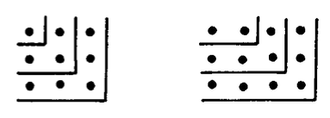
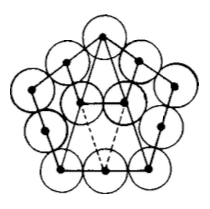
- However, while in these cases the original shape of the carpenter's tool is preserved, the same cannot be said for the gnomons of polygonal numbers. Here, for example, are the successive pentagonal numbers 1, 5 12, with their gnomons of 4 and 7:
- Während in diesen Fällen die ursprüngliche Form des Zimmermannswerkzeugs erhalten bleibt, gilt dies nicht für die Gnomone von polygonalen Arithmen (polygoˉnos / πολύγωνος). Hier sind zum Beispiel die aufeinanderfolgenden pentagonalen Arithmen (Fünf-Winkel) 1, 5, 12 mit ihren Gnomonen von 4 und 7 dargestellt.
 ☢
- Gnomon (gnoˉmoˉn / γνώμων): Ursprünglich der Winkelmaßstock eines Zimmermanns (L-förmig). In der Arithmetik grenzt diese Form in der archaischen Praxis, Arithmen als Punktanordnungen (pseˉphoi / ψῆφοι) darzustellen, die Folge der ungeraden (perittoˊs / περιττός) oder geraden (aˊrtios / ἄρτιος) Arithmen ab, welche jeweils Quadrate (tetraˊgnos / τετράγωνος) oder längliche Arithmen (heteromeˉkeˉs / ἑτερομήκης) bilden.
- Sesquialter: The ratio 3:2, which in music measures the concord of a fifth.
- Sesquioctave: The ratio 9:8, which in music is a whole tone.
- Sesquitertian: The ratio 4:3, which in music measures the concord of a fourth.
- Subcontrary: Originally used to describe the harmonic mean, as opposed to the arithmetic and geometric means. Later, these three were taken as the standards, and three of the further seven means which were distinguished were called 'subcontrary' (opposed)— one to the harmonic, the other two to the geometric. Example: in the proportion a:b:c, b is the geometric mean if (c-b)/(b-a)= b/a (e.g. 1, 2, 4). However, in the proportion a:b:c, b is the 'fifth' mean, and subcontrary to the geometric if (b-a)/(c-b) = b/a (e.g. 2, 4, 5).
- Subsesquialter: The inverse of the sesquialter, i.e. the ratio 2:3.
- Tetraktys: The decad considered as the sum of the first four numbers, and usually portrayed as a triangular number:
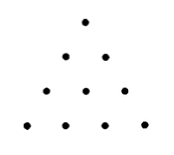
- The tetraktys was held in great reverence by the Pythagoreans, and was their basic model or map of how things are. Since the tetraktys contains all the numbers from 1 to 10, in a sense the whole of The Theology of Arithmetic is about the tetraktys. Many of the particular reasons why the tetraktys was so admired are given in the sections of the treatise which are devoted to the tetrad and the decad.


